
Copyright
Copyright law gives copyright owners a legal monopoly (with some limited exceptions) to control the use of their work for a limited period of time (see below). They can decide if and when to obtain commercial gain from their work by licensing any or all of these rights on an exclusive or non-exclusive basis:
- Reproduction: the right to make copies
- Distribution: the right to sell or otherwise distribute copies to the public
- Display: the right to display the work publicly
- Perform: the right to perform a motion picture or audio visual work publicaly
- Derivative works: the right to create adaptations
Who is the copyright owner?
In most cases the copyright owner is the person who created the work, i.e. the photographer. However if the creator was employed to create the work as an employee or as a work for hire, the employer is the copyright owner. Any copyright owner may transfer all of their rights to another person or company, who becomes the new copyright owner.
What images are in the public domain or available for public use?
- Any work created by the US government.
- Any work by US author first published or registered with the US Copyright Office more than 95 years ago.
- Any image explicitly transferred for broad public use by its author under a type of Creative Commons license or the like.
How long does copyright protection last?
Unfortunately there isn’t a simple answer, but the table below will help you determine if a particular US work may currently be in copyright.
For complete details of US copyright duration, refer to Circulars published by the Copyright Office or the Cornell University Copyright Information Center. Copyright laws in other countries vary, but generally provide copyright protection for the life of the author plus 50–70 years.
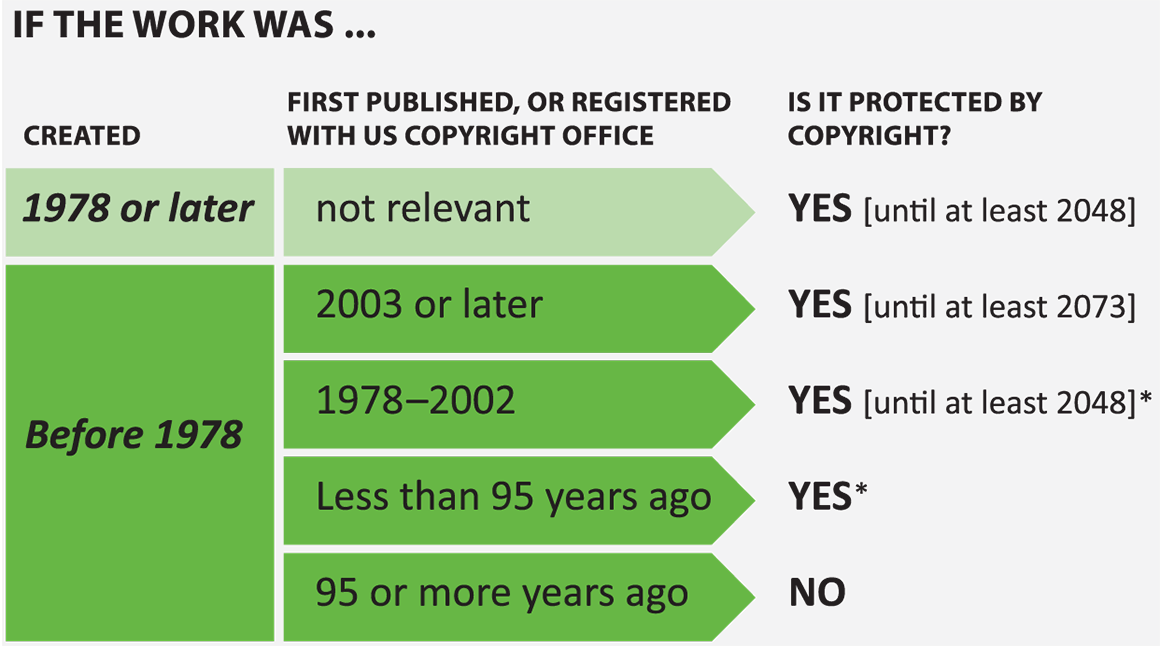
*The work is only protected if formalities were observed: e.g. publication with notice was required until March 1989 and renewal registration of published works was required after 28 years until 1964.
Fair use
The fair use doctrine under US copyright law provides a limited exception to copyright’s legal monopoly where the copyright holder’s permission is not required to use a copyrighted work. Section 107 of the Copyright Act provides that reproduction “for purposes such as criticism, news reporting, teaching (including multiple copies for classroom use), scholarship, or research” is not an infringement of copyright. This is not an exhaustive list.
A use may also be a fair use of another work if it does not replace the original work but adds something new, i.e. it transforms the original use and does not harm the market for the original work. Whether unauthorized use is fair use or copyright infringement is determined by the courts on a case-by-case basis by analysing four factors prescribed by the statute (see bit.ly/uscofu). Copyright law and the courts aim to strike a balance between public interest and the rights of authors/artists. It is a difficult doctrine to apply as the statute provides guidelines and not rules.
For example, reviewing a photograph that is part of a gallery opening is an example of fair use. To merely illustrate the subject of a blog or article with an image is generally not a fair use and would require a license from the copyright owner or authorized representative.
Orphan Works
An orphan work is one where the copyright owner is not known or not locatable.
Even if an owner cannot be identified or contacted, the image may be protected by copyright. If you use the image and the owner emerges, the owner may seek damages for the infringing use of the work.
Digital image and video files can contain textual information known as metadata, which may include the name of the copyright holder or his/her agent. If there is no credit with the image or in the metadata, you may need to engage a professional researcher or research service.
Useful online resources
- PicScout Platform allows you to search by image for a registered copyright holder.
- DMLA’s OrphanSearch service invites you to email an image. DMLA will forward your enquiry to all its members and affiliated associations.
- The PLUS Registry and US Copyright Office offer free online search tools.
- Google Image Search lets you upload an image to find matches on the Web: click on the camera icon in the search box.
- TinEye offers a similar search facility
Categories of use
Editorial Use
This is where a work is used to illustrate the content of a truthful article or news story of public interest published in a newspaper, magazine, book, documentary or news broadcast or other form of publication. If the main focus of the work bears a reasonable relationship to the content of the article or broadcast, releases from the subject are generally not required, under state right of privacy and publicity law.
Commercial use
This is where a work is used in connection with the sale or promotion of a product or service, or used in merchandise. Releases are always required for identifiable persons and certain properties (see next section).
Releases
Model and talent releases
Any person who is identifiable in an image or video has certain rights to privacy with respect to the commercial use of that image, and permission must be sought before publication. A person may be identifiable by something other than their face, e.g. a distinctive body part, hair style, tattoo, or clothing
For professional actors permission typically comes in the form of a talent release. For professional models and members of the general public, permission comes in the form of a model release.
A stock model release typically permits unrestricted commercial use in return for a one-off payment (usually made by the photographer), but there are instances where the model or talent stipulates restrictions, such as no association with a political party or a controversial subject.
Professional photographers and videographers arrange model and talent releases as a matter of course. Amateurs rarely do, and unless they recorded contact details for the people depicted, you will not be able to obtain a model release, limiting your use to editorial.
Property releases
Where a work depicts an identifiable object or design, permission may be required for commercial use and, in some instances, editorial use before publication.
In the case of editorial use, if the work bears a reasonable relationship to the article or broadcast, property releases are generally not required for editorial use. If however the work prominently features a property that that has no real relationship to the content of the article or broadcast, a property release may be required.
If however the work features a copyrighted work, or prominently features a property that that has no reasonable relationship to the content of the article or broadcast, a property release may be required. While state rights of privacy and publicity only applies to people, not personal or real property, some objects depicted in an image may be protected by copyright, and in some instances trademark or trade dress rights will apply depending on the context of the use (see next section).
Copyrighted works
Where a work depicts a copyrighted work (e.g. a painting, sculpture, graffiti, distinctive tattoo or unique furniture*) the permission of the copyright owner (typically the artist) is generally required for editorial or commercial use. Architecture built in the US after March 1, 1989 is protected by copyright, but the law permits any use of an image of a US building taken from a public location. (However the building may have trademark protection.) The same is not true of buildings in France, where the architect’s permission must be sought.
In the case of editorial use, if a copyrighted work is shown without permission, but is directly relevant to the article or broadcast, it may be a fair use to depict the subject.
* Useful objects are not protected under US copyright law but some countries provide design protection for distinctive designs.
Trademarks
Where a work depicts a trademark or trade dress (distinctive packaging), registered or not, the permission of the trademark owner may be required for certain commercial uses. The key test is whether the presence of the property in the image or video might confuse or deceive the viewer as to the origin, sponsorship or association of the goods or services being promoted. Where the identifiable object or mark is peripheral to the main focus of the work, or part of a larger composition (e.g. a cityscape), permission is generally not required.
Trademarked properties include all company logos and distinctive trade dress, such as the McDonald’s golden arches, Coke bottle shape, Tiffany Blue color, top of the Fender guitar, or Volkswagen beetle car. Some landmark buildings owners have attempted to assert trademark rights in recognizable features, such as the columns of the NY Stock Exchange, the radio city neon lights, and the top of the Transamerica building.
Recognizable private property
Where a work depicts private property with attributes that make it recognizable as belonging to a particular person or company (such as a yacht with a legible name) the permission of the owner may be required for commercial use.
Rights of privacy only apply to persons, so most images of animals do not require releases. Where an image depicts an animal that is a recognized commercial character (e.g. Geico Gecko), the permission of the owner is required for commercial use based on trademark rights.
Location releases
Photographing on private property requires the permission of the owner of the land or building. Even if photography or filming is permitted (say, in a museum), restrictions on commercial use of such photographs or videos may apply, requiring the owner’s explicit permission in the form of a location release (often termed a property release).
A work depicting real property taken from a public location does not generally require a location release, but one may be supplied for reassurance.
Licensing models
Licenses are an agreement between the copyright owner, or his/her representative, and you. There are two principal licensing models: rights managed, where a license is granted for a defined use, and royalty free, where a license is granted for a broad range of uses. There are also various free licensing models, of which Creative Commons is now the best established (for content).
Rights managed
The key characteristics of a rights managed license are:
- The fee is determined by the details of the usage.
- The usage is defined by a variety of parameters that may include image placement and size, publication medium, print run, duration, market sector, territories, and others.
- The license restricts use to the pre-agreed usage parameters. If you need to use the work outside those parameters, you must purchase an additional license.
Most rights managed content is available for licensing on an exclusive basis, where you are guaranteed exclusive use of the image within, say, a specified industry, territory or time period. The licensor will charge a premium for this exclusivity to cover the value of potentially lost sales.
A rights managed license for commercial use will typically include model or property releases applicable to the work, but you are still required to determine if the releases are adequate for your use.
Royalty free
The key characteristics of a royalty free license are:
- A one-time fee covers multiple uses in multiple projects for an unlimited period of time.
- The fee is determined by relatively few parameters, typically only the file size. Some licensors offer a choice of licenses at different price points, each covering a different bundle of uses.
- The range of acceptable uses is broadly defined by the licensor in advance advance but restrictions still apply so you must read the permitted and unpermitted uses.
- The license may not be transferred to another person or company.
- The license is always non-exclusive.
Microstock is a variety of royalty free, so called because of the low prices charged. The least expensive (‘standard’) licenses typically include restrictions on print runs and use in retail merchandise. A variety of more expensive ‘extended’ licenses with lesser restrictions are usually offered as well.
Subscription is a bulk licensing agreement that covers multiple images for a monthly or annual payment. The subscription agreement typically specifies:
- The permitted range of uses.
- The maximum number of works that may be downloaded during a period of time.
- The number of users who may download and use works. A standard license is typically single user with the option to add additional seat licenses.
Creative commons
Creative Commons is a very broad license that requires no payment, but typically requires attribution and may exclude commercial use. It may also forbid alteration (so no retouching or compositing). An owner of a work can select from a variety of licenses offered by Creative Commons so you must review the license restrictions to determine if the work is appropriate for your project.
Useful links
Further information on copyright may be found here:
- DMLA: the Ten Commandments
- Video and Powerpoint presentations by DMLA legal counsel Nancy Wolff
- Stock Image Copyright Law Quick Guide
- Copyright basics video
- Copyright Alliance
Acknowledgement
Visual Connections would like to thank the DMLA legal committee and Nancy Wolff, DMLA Counsel, for their assistance in writing this article.

Visual Connections accepts no liability for any inaccuracies in fact or interpretation in the information provided here, which does not constitute legal advice.